
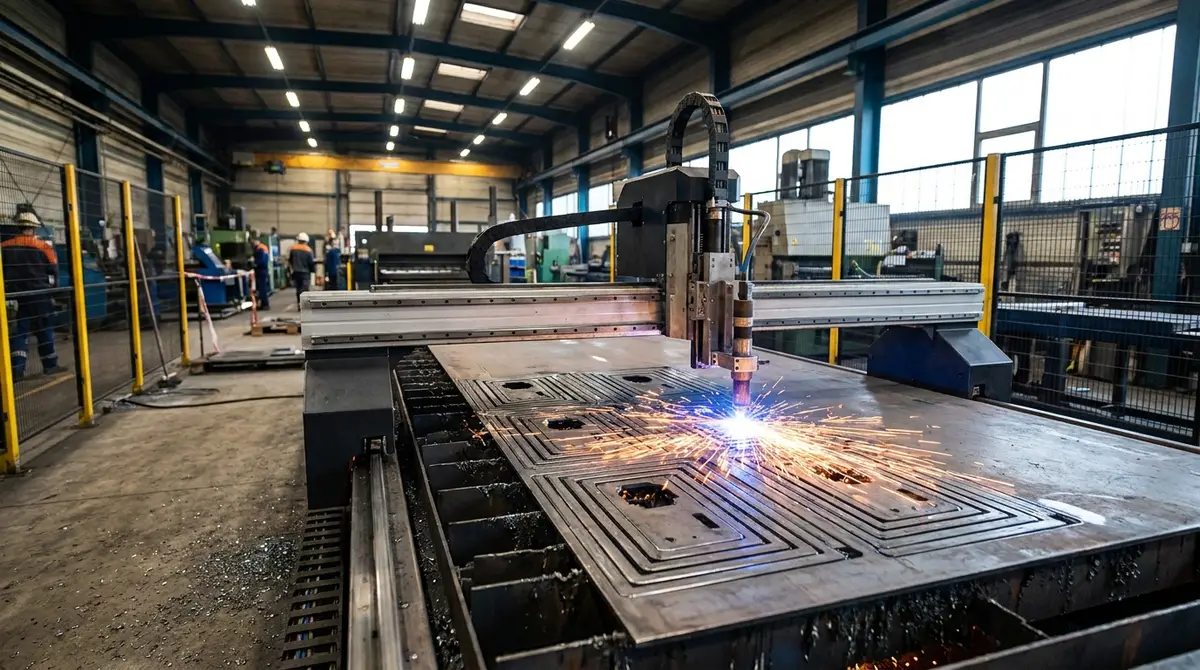
Every fabrication shop knows the drill: a new order comes in, someone prints the cut list, and a skilled operator spends twenty minutes playing Tetris with rectangles on a sheet of steel, plywood, or acrylic. They sketch layouts on paper, erase, redraw, and eventually commit to a nest that "looks about right."
That process feels normal. It's been normal for decades. But normal doesn't mean efficient—and in competitive manufacturing, inefficiency is expensive in ways that don't always show up on a single invoice.
The Real Numbers Behind Manual Nesting
Industry studies consistently show that manual nesting—even by experienced operators—typically achieves 70-85% material utilization. That means 15-30% of every sheet becomes scrap or offcut inventory that may never get used.
For a shop running $50,000 in monthly material costs, that's $7,500 to $15,000 in waste. Annually, that's $90,000 to $180,000 walking straight into the dumpster or piling up in a corner as "we'll use it someday" remnants.
But material cost is only the visible loss. The hidden costs compound:
- Operator time spent manually arranging parts (15-45 minutes per job)
- Delayed job starts while layouts are finalized
- Inconsistent nesting quality across different operators
- Rework when a layout doesn't fit and must be redone
- Storage and handling costs for offcut inventory
- Opportunity cost of tying up capital in excess material orders
How Algorithmic Nesting Actually Works
Cut optimization software uses computational geometry algorithms to solve what mathematicians call the "two-dimensional bin packing problem." The software evaluates thousands or millions of possible part arrangements in seconds, applying constraint rules that would take a human hours to consider manually.
Modern nesting algorithms account for:
- Grain direction requirements for wood or composite materials
- Kerf width (the material removed by the cutting tool)
- Minimum edge distances and part spacing
- Sheet defect zones to avoid
- Tool path efficiency to minimize cutting time
- Mixed-part jobs with varying quantities and sizes
The result is typically 88-96% material utilization—a 10-20 percentage point improvement over manual methods. On that same $50,000 monthly material spend, optimization can recover $5,000 to $10,000 in material costs monthly, or $60,000 to $120,000 annually.
Beyond Material Savings: Speed and Consistency
Material cost is the obvious win, but production speed improvements often deliver equal or greater value. An optimized nest is generated in under 60 seconds—compared to 15-45 minutes of manual layout work. For shops running multiple jobs daily, that time savings translates to:
Faster Job Turnaround
Jobs can move from order acceptance to cutting floor in minutes instead of hours. Rush orders become feasible. Lead times shrink. Customer satisfaction improves.
Operator Reallocation
Skilled operators stop doing layout math and focus on machine setup, quality control, or running additional equipment. Labor capacity increases without hiring.
Consistency is another underrated benefit. Manual nesting quality varies by operator experience, fatigue level, and time pressure. Algorithmic nesting delivers the same high-quality result every time, regardless of shift, operator, or job complexity. Quality becomes predictable.
Integration: Where Cut Optimization Meets Real Production Workflow
Stand-alone nesting software solves the geometry problem but creates a new problem: data silos. The nest exists in one system, the job order in another, inventory in a third, and the production schedule in a fourth. Operators toggle between applications, re-enter data, and introduce errors.
The breakthrough comes when cut optimization lives inside the production tracking system itself. When a job moves through your CRM pipeline and hits the production phase, the system already knows:
- What parts are needed (from the BOM)
- What materials are in stock (from inventory)
- What sheet sizes are available
- Which jobs are queued for the same material type
Integrated optimization can batch multiple jobs onto shared sheets, reducing setup changes and further improving material yield. When the nest is complete, cutting instructions flow directly to the shop floor station tablet. Operators see the optimized layout, confirm material loaded, and start cutting—no paper printouts, no manual transcription, no wondering if they're running the latest revision.
Jelly Flow: Production Tracking with Built-In Cut Optimization
JellyMachine's Jelly Flow module brings cut optimization into the same system that manages your shop floor stations, operator workflows, procurement, and inventory. When a job enters production, the Cut Optimizer analyzes the BOM, checks available material inventory, and generates an optimized nest automatically.
The nest appears on the operator's station tablet alongside all other job instructions. Material consumption updates inventory in real time. Offcuts are logged and tracked. If a sheet has a defect or a part needs to be re-cut, the optimizer regenerates the nest instantly with the updated constraints.
Because Jelly Flow also handles procurement—from BOM to purchase order to order confirmation to bill of lading—you can see material availability before committing to job schedules. The system can suggest order quantities based on upcoming job nests, reducing both excess inventory and emergency material orders.
For shops running CNC routers, laser cutters, plasma tables, or panel saws, this integration eliminates the manual handoffs that slow production and introduce errors. The entire flow—from customer order to optimized cut to finished part—happens in one system.
When Manual Nesting Still Makes Sense
Optimization isn't always the answer. For one-off prototype jobs with a single part on a single sheet, manual layout takes 30 seconds and optimization setup might take two minutes. For shops with highly irregular material shapes or extreme custom constraints, algorithmic nesting may require more configuration effort than it saves.
The break-even point typically arrives when:
- You're running more than 5-10 nesting jobs per week
- Jobs involve multiple parts per sheet
- Material cost is significant relative to labor
- You batch multiple orders onto shared sheets
- Lead time pressure makes layout speed critical
For most fabrication shops, CNC operations, cabinet makers, and metal service centers, that threshold is crossed quickly. The ROI on cut optimization—in material savings alone—often pays back in 2-4 months.
From Hidden Cost to Competitive Advantage
Manual nesting feels like a small inefficiency because it happens one job at a time, one sheet at a time. But small inefficiencies compound. Over a year, the material waste, operator time, and delayed jobs add up to six figures for many mid-sized shops.
Cut optimization flips that equation. Instead of losing 15-30% of material, you're using 92%+. Instead of spending 30 minutes per job on layout, you're spending 60 seconds. Instead of inconsistent results, you're delivering predictable quality.
When that optimization lives inside your production tracking system—where it can see inventory, batch jobs, and push instructions directly to the shop floor—the advantage multiplies. You're not just saving material. You're compressing lead times, reallocating labor, and making smarter procurement decisions.
That's the difference between a cost center and a competitive advantage. If you're ready to see what integrated production tracking and cut optimization can do for your shop floor efficiency, explore how JellyMachine's Jelly Flow module brings it all together at jellymachine.com.