
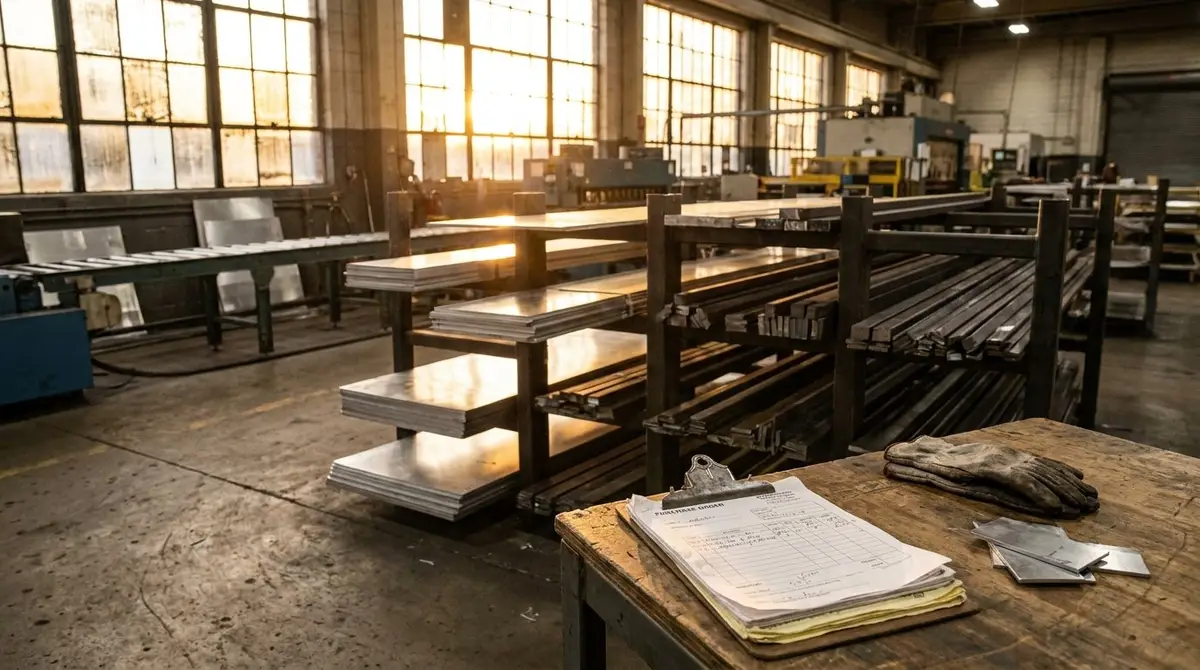
Every manufacturing operation has experienced it: the purchase order that arrives with the wrong material gauge. The rush order that sits in receiving for three days because nobody connected it to the urgent job on the floor. The supplier invoice that doesn't match the PO because someone verbally changed the spec mid-production. These aren't rare exceptions—they're the daily reality of disconnected procurement systems.
The fundamental problem isn't human error. It's architectural. Most manufacturers run procurement as a separate island: an ERP module, a spreadsheet tracker, or a standalone purchasing system that has no visibility into what's actually happening on the shop floor. When your Bill of Materials lives in one system, your Purchase Orders in another, and your production tracking in a third, every handoff becomes a game of telephone that costs real money.
The Hidden Tax of Procurement Isolation
Consider the typical flow: Engineering creates a BOM. Purchasing transforms it into a PO. Materials arrive and sit in receiving. Production eventually pulls them. At each transition, context evaporates. The purchasing agent doesn't see that Job #447 is already three days behind schedule and desperately needs those components. Receiving doesn't know that the material tolerance is critical for this particular customer's spec. The shop floor operator doesn't know the lead time just doubled on a key raw material.
This context loss manifests in measurable ways. Orders get placed too early, tying up working capital in inventory that won't be used for weeks. Orders get placed too late, forcing expensive expedited shipping or line stoppages. Quantities get rounded to supplier minimums without checking actual consumption rates, creating dead stock. Specifications drift between the BOM, the PO, and what actually arrives because there's no single source of truth that follows the material from plan to production.
The margin impact is brutal. A typical small-to-midsize manufacturer loses 2-4% of revenue to procurement inefficiencies: excess inventory carrying costs, expedite fees, scrap from wrong materials, and labor hours spent reconciling disconnected systems. On a $5M operation, that's $100K-$200K annually—enough to fund another production line or two additional skilled operators.
Why Spreadsheets and Standalone ERPs Break Down
The traditional solution—implementing a full enterprise ERP—often makes the problem worse for small and mid-sized manufacturers. These systems are designed for Fortune 500 complexity, requiring dedicated IT staff, extensive customization, and months of implementation. They're also notoriously rigid: when production reality diverges from the planned BOM (which happens constantly in custom manufacturing), the system becomes an obstacle rather than a tool.
Spreadsheet-based procurement seems flexible but creates its own nightmare. Version control disappears. Formulas break. Nobody knows if they're looking at the current BOM or last week's revision. The procurement spreadsheet doesn't talk to the production schedule, so rush jobs get the same lead time as routine orders. There's no audit trail when a specification changes, leading to finger-pointing when the wrong material shows up.
The Procurement-Production Integration Imperative
What manufacturers actually need is procurement that lives inside the production context. When a shop floor station signals that it's about to start a new job phase, the system should already know what materials are required, what's in stock, what's on order, and what needs to be expedited. When a PO is created, it should be linked directly to the job card, the BOM, and the production schedule—so everyone from the supplier to the receiving dock to the operator knows exactly why this material matters and when it's needed.
This integration eliminates the translation layers that destroy context. The BOM isn't a separate document that gets manually transcribed into a PO; it's the living specification that automatically generates procurement requirements based on actual production demand. When materials arrive, they're received against specific jobs, not generic inventory buckets. When an operator scans a material barcode at their station, the system knows if it's the right spec, the right lot, and the right quantity for that particular job phase.
Traceability From Quote to Shipping
The benefits extend beyond procurement efficiency. When BOMs, POs, and production tracking share a unified data model, you gain end-to-end traceability that's critical for quality control and customer accountability. If a customer questions a material spec six months after delivery, you can instantly trace from the shipped product back through the production phases, to the specific material lot, to the PO, to the supplier certification. This kind of forensic clarity is impossible when procurement and production live in separate systems.
Financial visibility improves dramatically as well. Job costing becomes accurate because material costs flow automatically from POs to job cards. You can see true margin by job, by customer, by product line—without manual reconciliation between your accounting system and your production records. Variance analysis becomes real-time rather than a month-end surprise.
Supplier Performance in Production Context
Integrated procurement also transforms supplier management. When lead times, quality issues, and delivery performance are captured in the same system that tracks production impact, you move beyond generic vendor scorecards to actionable intelligence. You can see which suppliers cause line delays, which ones consistently deliver early, and which materials have the highest scrap rates—all correlated with actual job outcomes rather than abstract metrics.
This data becomes negotiating leverage. Instead of vague complaints about late deliveries, you have specific evidence: "Your PO #3847 arrived four days late, which caused Job #562 to miss its ship date, costing us $2,400 in expedite fees to our customer." That's the kind of fact-based conversation that improves supplier relationships or justifies switching vendors.
How JellyMachine Closes the Procurement Loop
This is exactly the problem JellyMachine's Jelly Flow solves for manufacturers. The procurement flow is built directly into the production tracking system: BOM → Purchase Order → Order Confirmation → Bill of Lading. When you're planning a job on the shop floor, the system knows what materials you need. When you create a PO, it's linked to the specific job and production phase. When materials arrive, receiving scans them against the job context, not a disconnected inventory system.
The command-center dashboard shows procurement status alongside production status, so bottlenecks are visible immediately. If a critical PO is running late and a job is scheduled to start in two days, the system flags it as a risk. Operators at their station tablets can see material availability in real-time, not a stale inventory snapshot from yesterday. Andon alerts can trigger not just for production issues but for procurement problems—like a key material that's below reorder point while jobs are queued.
Because Jelly Flow integrates procurement with production tracking, you eliminate the context-switching tax. The same platform that manages your shop floor phases, your operator stations, and your job progress also manages the material flow that feeds those jobs. No more jumping between an ERP, a spreadsheet, and a production tracking tool. No more manual reconciliation. No more procurement decisions made in a vacuum.
The Bottom Line: Context Is Margin
Manufacturing margin lives in the details—the right material at the right time in the right quantity. Procurement systems that operate independently from production context force you to lose margin on every order through waste, delays, and carrying costs. The solution isn't a bigger ERP or a more complex spreadsheet. It's collapsing the distance between procurement decisions and production reality.
When your BOM, your PO, your receiving, and your shop floor all speak the same language in the same system, procurement becomes a competitive advantage rather than an administrative burden. Materials arrive exactly when needed. Specifications stay consistent from quote to delivery. Costs flow accurately into job margins. Suppliers are managed with data, not guesswork. That's not just operational efficiency—it's how small manufacturers compete with larger competitors who have dedicated procurement teams.
The manufacturers who thrive in the next decade won't be the ones with the most sophisticated standalone ERP modules. They'll be the ones who refused to accept procurement as a separate island and instead built unified workflows where context flows seamlessly from customer quote through production to final invoice. That architectural decision—integration over isolation—is worth far more than any individual software feature.