
The Invisible Revenue Problem
Every manufacturing business faces a fundamental paradox: the moment production completes is rarely the moment an invoice gets generated. Between the shop floor operator marking a job done and the accounting team creating a billable document, hours or days evaporate. In that gap, revenue sits in limbo—work completed but not recognized, value delivered but not captured.
This isn't a minor operational hiccup. It's a structural flaw that cascades through cash flow projections, financial reporting accuracy, and customer relationships. When your production system can't communicate completion status to your billing system in real time, you're not just losing administrative efficiency—you're fundamentally breaking the connection between work performed and revenue recognized.
The Three Revenue Recognition Failure Modes
Manufacturing revenue recognition breaks down in predictable patterns. The first is the completion blind spot: production finishes a job, but the information never reaches the billing team. The operator moves to the next task, the completed work sits in shipping, and days later someone manually discovers the job is done and scrambles to invoice.
The second failure mode is partial completion chaos. Multi-phase jobs create billing complexity—should you invoice at 50% completion? When the first phase ships? When the entire order finishes? Without phase-level tracking that ties directly to billing rules, manufacturers either over-invoice (damaging customer trust) or under-invoice (starving cash flow).
The third mode is the variance reconciliation nightmare. The quote promised 100 units at $50 each. Production actually delivered 98 units due to material defects. The invoice gets generated from the original quote, not the actual completion data. The customer disputes the charge, the sales team investigates, and the billing cycle extends by weeks—all because production reality never updated the billing system.
Why Spreadsheets and Memory Don't Scale
Small manufacturers often rely on shop floor managers who "just know" when jobs are done and manually trigger invoicing. This works until it doesn't. The manager takes vacation, a rush order creates chaos, or the business grows beyond one person's mental capacity to track every active job.
Spreadsheet-based production tracking creates a different trap: someone has to manually update completion status, then someone else has to check that spreadsheet before generating invoices. The two-step process introduces delay and error. If the spreadsheet update happens Friday afternoon and the billing team works Monday through Thursday, that's a minimum three-day revenue recognition lag built into the system architecture.
The Financial Reporting Cascade
Revenue recognition delays don't just affect cash flow—they distort every downstream financial metric. Work-in-progress (WIP) inventory values become unreliable when completed jobs sit uncategorized. Gross margin calculations skew when labor and material costs post immediately but revenue recognition lags. Monthly financial statements show artificial volatility as batches of late invoices finally clear.
For manufacturers with investors, lenders, or acquisition prospects, this creates real credibility problems. A potential buyer's due diligence team sees erratic revenue patterns and questions whether the business actually understands its own operations. A lender reviewing quarterly statements sees revenue lumps instead of smooth trends and prices the risk accordingly.
The Customer Experience Dimension
Late invoicing doesn't just hurt the manufacturer—it frustrates customers who need timely billing for their own accounting cycles. A customer with net-30 payment terms expects the invoice within days of delivery, not two weeks later. When invoices arrive late and unpredictably, customers can't plan their own cash flow, and the manufacturer's payment reliability suffers.
Worse, invoice timing errors create disputes that damage relationships. A customer receives an invoice for work they haven't yet received because the billing system triggered on estimated completion instead of actual delivery. Or they receive no invoice at all for work completed weeks ago, then suddenly get hit with a surprise charge. Both scenarios erode trust and make the manufacturer look disorganized.
The Integration Solution: Production Tracking That Triggers Billing
The solution isn't better spreadsheets or more diligent manual processes—it's eliminating the gap between production completion and invoice generation entirely. When shop floor operators mark phases complete in a system that directly connects to billing workflows, revenue recognition happens in real time.
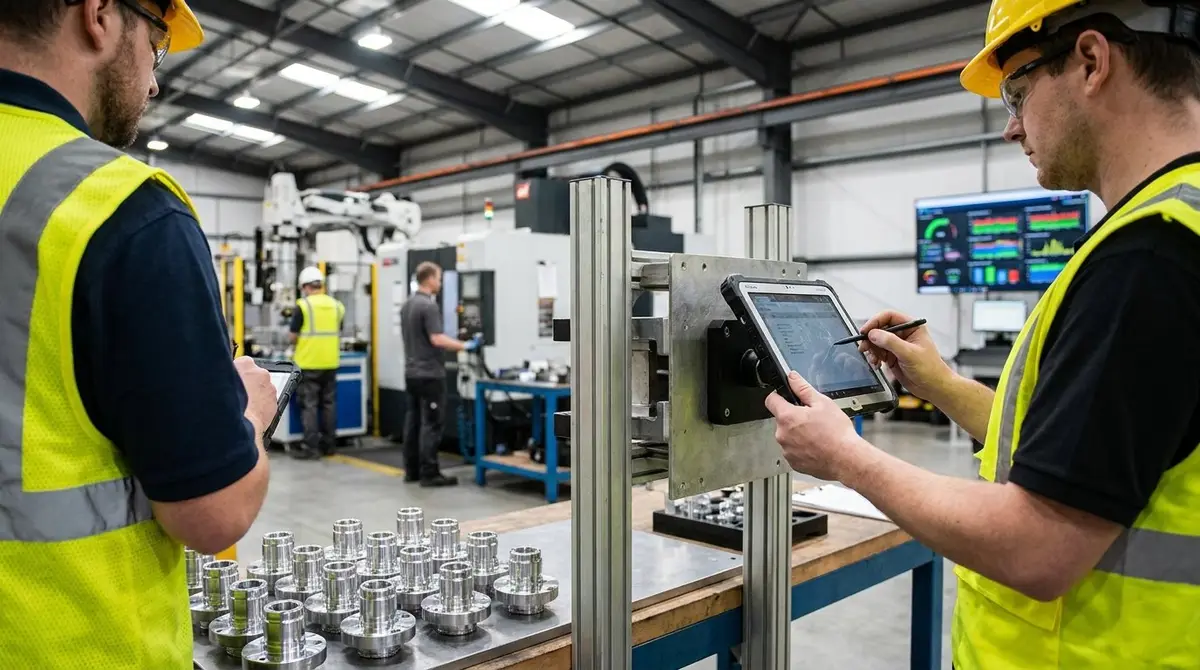
This is where JellyMachine's Jelly Flow production tracking becomes financially critical, not just operationally convenient. When operators use station tablets to mark production phases complete, that status update doesn't just inform the command center dashboard—it can trigger automated invoicing rules. A job completes its final phase, the system checks the associated quote or sales order, and an invoice generates automatically with actual quantities and completion dates.
The integration extends beyond simple completion triggers. Because Jelly Flow tracks material consumption and labor time at the phase level, invoices can reflect actual costs versus quoted costs. If a job used more material than estimated, the billing system knows. If a custom order required additional phases not in the original quote, those get captured and billed. The invoice becomes a true record of work performed, not just a copy of the original estimate.
From Revenue Trap to Revenue Precision
Manufacturers who close the production-to-invoice gap don't just speed up billing cycles—they fundamentally improve financial accuracy and customer relationships. Revenue gets recognized when earned, not when someone remembers to generate paperwork. Cash flow becomes predictable because invoicing happens on a consistent timeline tied to actual production completion. Financial statements reflect operational reality instead of administrative lag.
The competitive advantage compounds over time. While competitors scramble to reconcile production records with billing systems at month-end, integrated manufacturers already have accurate financials. While others lose revenue to forgotten invoices and disputed charges, integrated systems ensure every completed job gets billed correctly and promptly.
The revenue recognition trap only exists when production tracking lives separately from billing systems. Eliminate that separation, and the trap disappears—replaced by a seamless flow from shop floor completion to customer invoice, with every dollar of earned revenue captured the moment it's created.