
The Invisible Break in Your Production Chain
Walk onto any manufacturing floor and watch what happens when a job moves from welding to assembly, or from cutting to finishing. An operator completes their work, scribbles a note on a traveler sheet, and places the part in a bin. The next operator picks it up hours later—sometimes without the traveler, sometimes with illegible notes, often with no context about what happened at the previous station.
This handoff moment is where production data goes to die. Quality issues discovered three stations downstream can't be traced back to their source. Bottlenecks hide in the gaps between phases. Managers have no real-time view of where jobs actually are or which operators touched them last. The shop floor becomes a black box with inputs and outputs but no visibility into the transformation happening inside.
The root problem isn't operator negligence or poor training. It's that manual handoff systems—paper travelers, verbal instructions, physical bins—create discontinuity by design. Every station operates in isolation, recording its own version of reality with no shared source of truth.
Why Traditional Handoffs Fail
Paper-based production tracking forces each station to reinvent the wheel. When a job arrives, the operator must decipher previous notes, verify the work order number, and figure out what's expected—all before starting actual productive work. If the traveler is damaged, missing, or incomplete, they're working blind.
The handoff itself creates a data gap. Between the moment one operator marks a phase complete and the next operator begins work, the job exists in limbo. Is it waiting for inspection? Sitting in a queue? Lost in transit? Management has no way to know without physically walking the floor and asking questions.
Quality traceability collapses across these gaps. When a defect surfaces in final inspection, reconstructing the job's history requires hunting down multiple operators, cross-referencing timestamps on paper forms, and hoping everyone's handwriting is legible. Root cause analysis becomes archaeology instead of data review.
The Accountability Blind Spot
Manual handoffs obscure accountability in ways that hurt both operators and management. When quality issues arise, it's often impossible to determine which station introduced the problem. This creates two equally bad outcomes: either everyone gets blamed collectively (destroying morale), or no one gets blamed at all (preventing process improvement).
Operators working in good faith have no protection when handoffs fail. If the previous station made an error but didn't document it, the next operator who discovers the issue becomes the suspect. Without timestamped phase tracking tied to specific user accounts, proving what happened when becomes a matter of conflicting testimonies rather than objective records.
Management loses the ability to identify training opportunities or reward excellence. Which operators consistently complete phases faster without sacrificing quality? Which stations have the longest queue times? Which handoffs create the most rework? Paper systems can't answer these questions at scale.
Digital Continuity Changes the Game
Digital phase tracking systems eliminate handoff gaps by creating a continuous thread of data that follows each job from start to finish. When an operator completes a phase on a station tablet, that action is timestamped, user-attributed, and immediately visible to the next station in the sequence.
The next operator doesn't need to decipher notes or verify work orders—they scan or select the job, and the system shows exactly what was done previously, by whom, and when. Instructions, specifications, and quality checkpoints are presented digitally, ensuring every operator works from the same source of truth.
This continuity extends beyond individual jobs to the entire production floor. Real-time dashboards show which jobs are at which phases, how long they've been there, and whether they're on schedule. Bottlenecks become visible the moment they form, not hours later when someone notices a pile-up.
From Handoff Gaps to Seamless Flow
The shift from manual to digital handoffs isn't just about replacing paper with screens. It's about fundamentally changing how production work flows through your facility. Instead of jobs moving through isolated stations connected by physical handoffs, they move through an integrated system where every phase builds on verified data from the previous one.
Quality traceability becomes automatic. When an issue is discovered, managers can instantly pull up the complete phase history: which operators worked on the job, what timestamps they logged, what notes they entered, and what specifications they followed. Root cause analysis shifts from guesswork to data review.
Accountability becomes fair and objective. Operators know their work is being tracked accurately, which protects them from false blame and gives them credit for excellent performance. Management gains the visibility needed to identify training needs, optimize workflows, and reward top performers based on actual data.
How JellyMachine Solves Station Handoffs
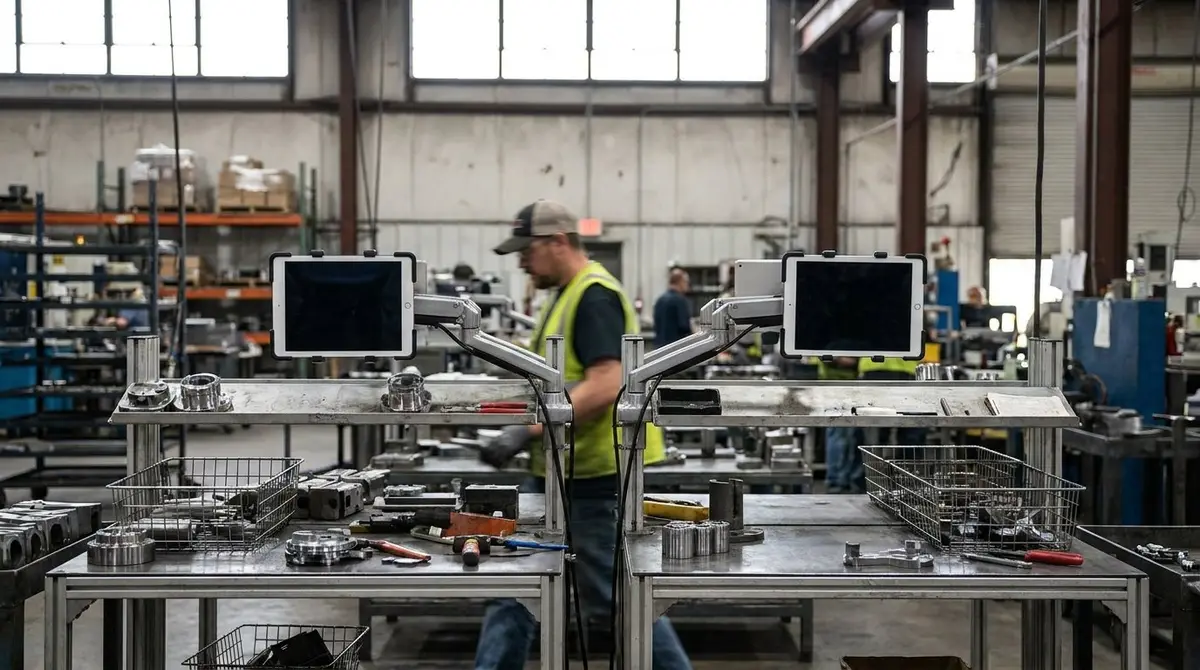
JellyMachine's Jelly Flow module is purpose-built for production environments where handoff continuity matters. Each work order flows through defined station phases, with operators using dedicated tablets to log phase starts, completions, and quality checkpoints in real time.
When an operator completes a phase, the system automatically timestamps the action, records the operator's identity, and makes the job visible to the next station in the workflow. No paper travelers to lose, no verbal instructions to misinterpret, no data gaps between phases. The command-center dashboard gives management a live view of every job's location and status across the entire shop floor.
Andon alerts notify supervisors the moment a station reports an issue, enabling immediate intervention instead of discovering problems hours later. The complete phase history for every job creates a permanent quality record that supports continuous improvement and protects operator accountability.
By replacing manual handoffs with digital phase tracking, JellyMachine eliminates the production continuity gaps that plague traditional manufacturing operations—turning the shop floor from a black box into a transparent, data-driven system.